What Should I Do After Law Enforcement?
Jun 08, 2026
“What should I do after law enforcement?”
This is one of the most common questions I hear when officers, deputies, correctional officers, and federal agents call me about transitioning into the private sector.
It is also one of the hardest questions to answer.
Not because there are no good options. There are plenty of good options. In fact, there are more private sector careers available to law enforcement officers than most realize. The hard part is that every officer is different. Everyone has a different background, different financial situation, different family dynamic, different tolerance for risk, different personality, different experience, and different vision for what they want life to look like after the badge.
Some officers are ready to completely leave public safety behind. They do not want to carry a gun, wear a uniform, work nights, respond to emergencies, or be around the same stress they experienced during their law enforcement careers.
Others still love the mission. They want to stay close to public safety, investigations, security, or emergency operations, but they want to do it in a healthier environment, with better pay, more flexibility, or a better long-term career path.
Some officers want remote work. Some want travel. Some want a leadership role. Some want to work alone. Some want a high-paying sales career. Some want something stable and predictable. Some want to build a business. Some want to retire from law enforcement and take a second career that gives them purpose without consuming their entire life.
That is why “what should I do after law enforcement?” cannot be answered with one job title.
The better question is this:
What do you want your next career to do for your life?
That is where the transition really begins. And this is where I believe I help LEOs the most.
When I left law enforcement, I quickly realized how little guidance exists for officers preparing for life beyond the badge. Most agencies do not have anything resembling a transition program. We hire people, train them, promote them, and ask them to give everything they have to the profession. But when they retire, resign, burn out, get injured, or simply decide they want a new chapter, many are left to figure it out alone.
That is a problem because the law enforcement transition is not like leaving a normal job. For many of us, this career became part of our identity. We did not just work as police officers, deputy sheriffs, correctional officers, or federal agents. We became those things. The badge shaped how we saw ourselves, how others saw us, and how we moved through the world.
So when an officer asks me what they should do next, I do not take the question lightly. It is not just a career question. It is a life question.
The good news is this: law enforcement officers have far more to offer the private sector than they usually realize.
You have solved problems under pressure. You have made decisions with incomplete information. You have written reports that mattered. You have interviewed victims, witnesses, and suspects. You have de-escalated conflict. You have managed risk. You have protected people, property, and organizations. You have worked with attorneys, community leaders, command staff, prosecutors, business owners, schools, hospitals, and government agencies. You have learned how to communicate with almost anyone.
Those skills are so valuable. The challenge is learning how to translate them.
Private sector employers do not always understand what it means to be a patrol officer, detective, supervisor, FTO, background investigator, school resource officer, K9 handler, crisis negotiator, recruiter, or command staff member. They may not understand your rank structure, your caseload, your call volume, your collateral duties, or the amount of responsibility you carried.
That is your job during the transition. You need to take everything you have done in law enforcement and explain it in a way civilian employers can understand.
Once you learn to do that, new career paths start to open. Visit RecruitingHeroesLLC.com to learn more about how I've helped nearly 800 law enforcement officers with their transition to the private sector!
And check out my best-selling book, Beyond the Thin Blue Line. In it I walk you through the exact process of figuring out your dream career after the uniform and the steps to get there. Get your copy here: Beyond the Thin Blue Line: Career Strategies for Law Enforcement Officers
Here are five exciting private sector roles law enforcement officers should consider.
1. Corporate Investigator or SIU Investigator
This is one of the most natural transitions for many officers.
If you enjoyed investigations, interviews, report writing, evidence review, surveillance, fraud cases, theft cases, crash investigations, financial crimes, elder exploitation, organized retail crime, or internal investigations, this may be a strong fit.
Corporate investigators and Special Investigations Unit investigators are hired by insurance companies, banks, retailers, healthcare organizations, technology companies, law firms, and large corporations to investigate fraud, misconduct, claims, theft, workplace issues, and suspicious activity.
The work can include reviewing documents, analyzing records, interviewing people, identifying inconsistencies, preparing reports, working with legal or compliance teams, and referring cases to law enforcement when appropriate.
Sound familiar? It should.
Law enforcement officers investigate problems for a living. Even if you were never a detective, you likely conducted investigations throughout your career. Patrol officers investigate thefts, assaults, domestic incidents, fraud reports, traffic crashes, death investigations, missing persons, and countless other calls. Detectives and specialized investigators bring even deeper experience.
The private sector needs people who can find facts, document them clearly, and make sound recommendations. That is exactly what good investigators do.
This can be a great career path for officers who want to use their investigative skills without staying in a sworn law enforcement role. It can also offer opportunities for remote work, field work, travel, and advancement into management.
Possible job titles to search include:
- Corporate Investigator
- SIU Investigator
- Claims Investigator
- Fraud Investigator
- Internal Investigations
- Specialist Ethics and Compliance Investigator
- Organized Retail Crime Investigator
- Background Investigator
This path is especially strong for officers who are detail-oriented, analytical, patient, comfortable writing reports, and able to remain objective.
2. Corporate Security Manager or Physical Security Specialist
Many officers immediately think of security after law enforcement, but they often think too narrowly.
They imagine a low-paying security guard job sitting at a desk overnight. While those jobs exist, that is not what I am talking about.
Corporate security can be a highly professional, strategic, and well-paying career field. Large companies need professionals who can protect facilities, employees, executives, assets, data centers, warehouses, retail locations, campuses, manufacturing sites, and global operations.
This work can include physical security assessments, access control, emergency response planning, workplace violence prevention, executive protection, vendor management, security technology, incident response, investigations, policy development, and coordination with law enforcement.
For officers who enjoyed leadership, operations, planning, threat assessment, crime prevention, emergency management, or protecting people and places, this can be an excellent fit.
Law enforcement officers understand risk in a way many people do not. You have walked into unknown situations. You have identified suspicious behavior. You have protected scenes. You have responded to emergencies. You have made safety decisions quickly. You have learned how small vulnerabilities can become major problems.
Companies value that experience.
This field can also offer a strong long-term career path. You may start as a security specialist, investigator, site security manager, or physical security coordinator and eventually move into roles such as regional security manager, director of security, global security operations manager, or chief security officer.
Possible job titles to search include:
Corporate Security
Manager Physical Security
Specialist Security Operations Manager
Regional Security Manager
Protective Services Manager
Workplace Violence Prevention Specialist
Threat Management Specialist
Security Risk Manager
Executive Protection Specialist
This path may be especially attractive to supervisors, command staff, detectives, school resource officers, crime prevention officers, emergency management personnel, and those with experience managing security-related programs.
Certifications such as CPP, PSP, PCI, or other ASIS credentials can also help strengthen your competitiveness in this field.
3. Program Manager or Project Manager
This is one of the most overlooked career paths for law enforcement officers.
Many officers hear “project manager” and assume they are not qualified because they never held that exact title. But if you led initiatives, managed operations, supervised people, coordinated events, oversaw training, implemented new programs, handled recruiting, managed accreditation projects, coordinated with vendors, supervised a unit, or tracked deadlines and deliverables, you have project management experience.
You just may not have called it that.
A project manager is responsible for moving work from idea to completion. They coordinate people, timelines, resources, budgets, expectations, and outcomes. They make sure things get done.
Law enforcement officers do this constantly.
Think about a large investigation, a recruiting campaign, a community event, a training program, a policy rollout, a new technology implementation, a special operation, a traffic safety campaign, a grant-funded initiative, or a multi-agency response. Those are projects.
You identified the objective, coordinated stakeholders, managed resources, handled problems, communicated updates, and worked toward a successful outcome.
That is project management.
This can be a great path for officers who enjoy organization, leadership, problem-solving, communication, and execution. It can also lead to opportunities in public safety technology, consulting, government contracting, healthcare, logistics, construction, cybersecurity, corporate operations, and many other industries.
Possible job titles to search include:
- Project Manager
- Program Manager
- Operations Manager
- Implementation Manager
- Client Delivery Manager
- Public Safety Program Manager
- Training Program Manager
- Business Operations Manager
- Project Coordinator
If you are interested in this path, consider looking at certifications such as PMP, CAPM, Lean Six Sigma, or Scrum Master. You do not always need them, but they can help translate your experience into private sector language.
This is also a strong option for supervisors, FTOs, training officers, recruiters, accreditation managers, emergency management personnel, command staff, and anyone who has been responsible for building or improving a process.
4. Customer Success Manager or Account Manager in Public Safety Technology
This is one of the most exciting and underappreciated paths for officers who still care about the mission but want to leave the daily grind of law enforcement.
Public safety technology companies need people who understand law enforcement. They need professionals who can speak the language of police departments, sheriff’s offices, correctional agencies, emergency communications centers, prosecutors, and government leaders.
They need people who know how agencies operate, what command staff care about, what patrol officers actually need, what slows down adoption, what makes technology useful, and what makes it fail.
That is where former law enforcement officers can be incredibly valuable.
Customer success managers and account managers help clients get value from a company’s product or service. They build relationships, solve problems, train users, coordinate with internal teams, identify client needs, and help ensure the customer is successful.
If you worked in recruiting, training, community policing, public information, technology implementation, supervision, or any role where you built relationships and solved problems, you may have the foundation for this career. In fact, this was the career path I was considering pursuing before I started my company!
This path is especially strong in public safety technology because your law enforcement background becomes a differentiator. You are not just someone trying to sell or support software. You are someone who has been in the field and understands the end user.
Possible job titles to search include:
- Customer Success Manager
- Account Manager
- Client Success Manager
- Implementation Specialist
- Solutions Consultant
- Public Safety Consultant
- Sales Engineer
- Training Specialist
- Business Development Representative
- Law Enforcement Liaison
This field can also be financially rewarding. Some roles are salary-based, while others include commission or bonus opportunities. Sales and account management roles can be uncomfortable for officers at first because many have never thought of themselves as salespeople. But law enforcement is full of relationship-building, persuasion, communication, trust-building, and problem-solving.
That is sales.
You had to get people to talk to you, calm down, cooperate, provide information, follow instructions, and trust your recommendations. Those are highly transferable skills.
This path is a great fit for officers who are strong communicators, comfortable building relationships, interested in technology, and willing to learn the business side of public safety.
5. Risk, Compliance, or Fraud Analyst
If you enjoy analyzing information, identifying patterns, reviewing records, managing risk, or finding problems before they become bigger problems, this path is worth exploring.
Companies in banking, insurance, fintech, healthcare, retail, government contracting, and technology hire risk, compliance, and fraud professionals to protect the organization from financial loss, regulatory violations, misconduct, fraud, and reputational damage.
These roles may involve reviewing alerts, analyzing transactions, investigating suspicious activity, writing reports, identifying trends, escalating concerns, coordinating with legal or compliance teams, and recommending process improvements.
Again, much of this should sound familiar.
Law enforcement officers are trained to identify risk. You look at behavior, context, patterns, and inconsistencies. You know when something does not feel right. You know how to document facts. You know how to ask questions. You know how to follow a lead.
Those skills translate well into risk and compliance roles.
Possible job titles to search include:
- Fraud Analyst
- Risk Analyst
- Compliance Analyst
- AML Investigator
- Financial Crimes Investigator
- Trust and Safety Specialist
- Insider Threat Analyst
- Threat Intelligence Analyst
- Loss Prevention Analyst
- Global Security Operations Analyst
This can be a great option for officers who want a more analytical role, possibly with remote or hybrid flexibility. It can also be a strong path for those who worked financial crimes, narcotics, organized retail crime, cybercrime, intelligence, internal affairs, background investigations, or patrol.
Some roles may require certifications or industry knowledge. Depending on your target area, certifications like CFE, CAMS, CCEP, Security+, or intelligence-related training may help.
The key is to study job postings and identify what employers consistently ask for.
How Do You Figure Out Which Role Is Right for You?
The five careers above are only a starting point. There are many other strong options for law enforcement officers, including emergency management, executive protection, background investigations, human resources, recruiting, training, intelligence, cybersecurity, consulting, private investigations, insurance claims, safety management, and entrepreneurship.
The goal is not to pick a job title because someone on LinkedIn told you it was a good career. The goal is to make an informed decision. Here is how to start.
Step 1: Take Inventory of Your Career
Before you start applying for jobs, write down what you have actually done. More importantly, write down what you actually enjoyed doing! I have all my candidates do this exercise (did I mention I help LEOs transition to the private sector!?). Write out 10-15 things about your law enforcement career that inspired you and made you excited to come to work. These shouldn't be job titles or ranks. Maybe it's the type of calls you handled, investigations you conducted, programs you managed, skills, trainings, etc.
Step 2: Search Job Boards by Skill, Not Just Title
A lot of officers make the mistake of searching only for obvious titles like “investigator,” “security,” or “law enforcement.” That's too limited. Or worse... they don't know what to search for so they feel completely lost and overwhelmed.
The great thing about LinkedIn and other job boards is that you can search by skills and interests, not just job titles.
Try terms like investigations, risk management, fraud, compliance, physical security, threat assessment, program management, public safety, customer success, training, emergency management, intelligence, background investigations, loss prevention, and operations.
Then, read some of the job descriptions for roles that come up. The actual job, company, salary, etc. doesn't matter that much just yet. Look for patterns.
What duties interest you? What requirements keep showing up? What certifications are common? What industries seem to value your background? What roles make you think, “I could see myself doing that”?
This process will help you discover career paths you may not have known existed.
Step 3: Talk to People Already Doing the Job
Do not rely only on job postings.
Find people on LinkedIn who are already in the roles you are considering. Even better, find former law enforcement officers who made the transition into those roles. Ask them about the reality of the job.
What do they like? What do they dislike? What surprised them? What skills mattered most? What do they wish they had done before transitioning? What certifications helped? What would they avoid?
These conversations can save you months of confusion and help you avoid taking the wrong job.
Networking is not asking strangers for favors. It is building professional relationships and learning from people who are already where you may want to go.
Step 4: Build a Transition Plan
Once you identify a few possible paths, build a plan.
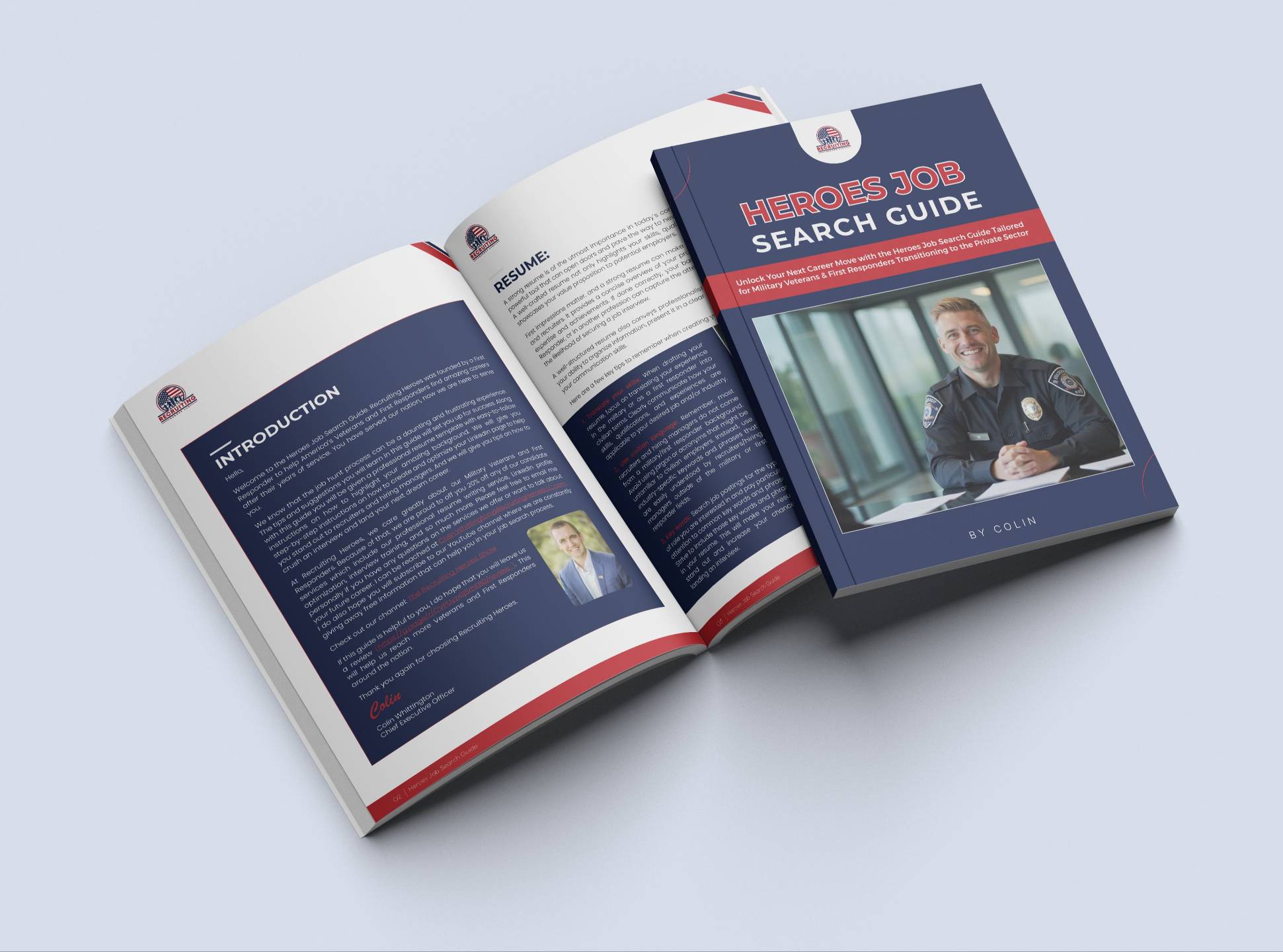
Update your resume. A strong resume is absolutely essential in the private sector job search process. They may not mean much in law enforcement. But in the civilian world they are often the first thing a company sees of you. And with over 350 other candidates (the average number of applications per job opening right now!), a week resume doesn't get you interviews. Need help? I'm a professional resume writer! Let's work together to get you a phenomenal resume. Learn more here: Professional Resume Writing Service
Optimize your LinkedIn profile. Recruiters in the civilian world utilize LinkedIn to find candidates. So, this isn't about posting and becoming an influencer. This is about having a profile that gets the attention of those who matter in your desired industry. I can help with that too: https://www.recruitingheroesllc.com/offers/PLAu76Fd/checkout
Start networking. This one is huge. Who you know is often more important than what you know.
Identify certification gaps. Certs/trainings are incredibly important and a great way to stand out. Check out my free Certs and Trainings guide that list out some of the most important ones in a variety of industries and includes the links to where you can learn more about each one and sign up: https://www.recruitingheroesllc.com/free-resources
Do not wait until two weeks before retirement. Do not wait until you are burned out and desperate. Do not wait until you are so frustrated that you take the first offer just to escape. Give yourself time. The earlier you start, the more options you will have.
Final Thoughts
So, what should you do after law enforcement? The answer depends on you.
It depends on your skills, your interests, your family, your finances, your goals, and what you want the next chapter of your life to look like. Just know, you are not stuck. You are not “just a cop.” You are not starting from zero.
You have built a career around leadership, communication, problem-solving, investigations, risk management, crisis response, and service. Those skills matter in the private sector. They matter more than you probably realize.
Your job now is to slow down, take inventory, translate your experience, explore your options, talk to people, and build a plan. There are exciting careers waiting for law enforcement officers who are willing to prepare for them.
You served your community. You handled the hard calls. You made sacrifices most people will never understand. You earned the right to think seriously about what you want next.
Life after law enforcement can be challenging. It can be emotional. It can be uncomfortable. But it can also be exciting.
If I can help you in any way, please don't hesitate to reach out to me!
Stay safe, Heroes!
Colin