Background Investigator - A High-Demand Investigations Career Path for Law Enforcement Professionals
May 26, 2026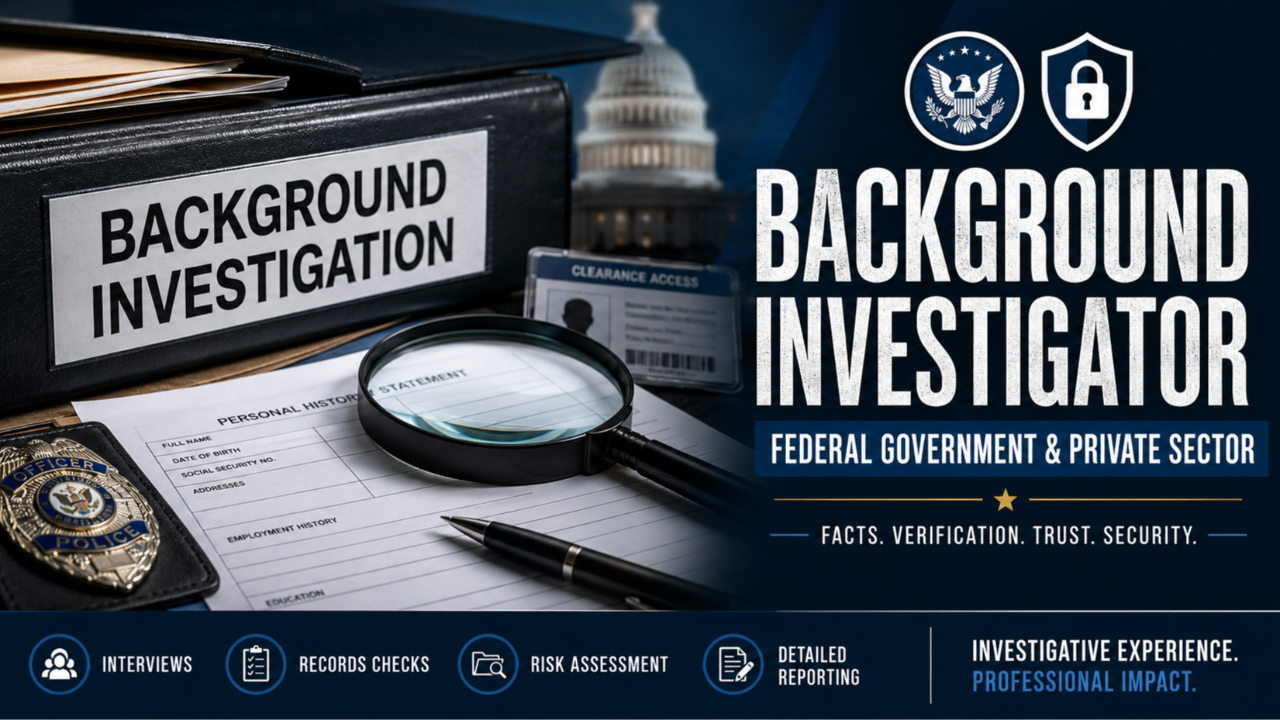
This article is part of my ongoing series designed to help law enforcement professionals successfully transition into high-value private-sector and federal civilian careers. In each installment, I break down a specific role, explain why it is a strong fit, and show you how to position your experience through your resume, LinkedIn profile, cover letter, and interview strategy.
So far, we have covered several strong transition roles including Corporate Investigations Manager, SIU roles, Fraud Investigator, Security Manager, Threat Intelligence Analyst, Risk & Compliance, SOC Analyst, Private Investigator, and Physical Security Specialist positions. Each of these roles leverages investigative experience in different ways across government and industry.
In this article, we are focusing on one of the most overlooked but powerful transition paths available: Background Investigator roles in both the federal government and private sector.
This is a highly stable, consistently in-demand career field that aligns extremely well with law enforcement experience, particularly for professionals with backgrounds in investigations, interviewing, report writing, records analysis, and sensitive information handling.
If you have experience conducting interviews, verifying facts, writing reports, reviewing records, handling confidential information, or supporting personnel-related investigations, this can be a very natural and lucrative transition.
Remember, I am a professional resume writer wand I pride myself on helping law enforcement professionals articulate their experience in a way that resonates with private sector employers. Learn more about my Resume Writing service here: https://www.recruitingheroesllc.com/offers/FKKLoiqJ/checkout
You can also grab a copy of my book, Beyond the Thin Blue Line, which breaks down strategies for successfully transitioning from law enforcement into civilian careers. Get your copy here: Beyond the Thin Blue Line: Career Strategies for Law Enforcement Officers: Whittington, Colin: 9798218441524: Amazon.com: Books
WHAT IS A BACKGROUND INVESTIGATOR?
A Background Investigator is responsible for conducting detailed investigations into an individual’s personal, professional, financial, and criminal history to determine suitability for employment, security clearance eligibility, or sensitive position access.
These roles exist in both:
- Federal government agencies (security clearance investigations)
- Private sector organizations (pre-employment screening and compliance)
Unlike criminal investigations, background investigations focus on fact verification, risk assessment, and suitability determination rather than enforcement or prosecution.
Background Investigators commonly review:
- Criminal history records
- Employment history verification
- Education verification
- Financial history (credit and debt indicators)
- Personal references and interviews
- Military records (if applicable)
- Residence history
- Foreign contacts and travel
- Behavioral and integrity indicators
- Drug and alcohol use history (depending on clearance level)
In the federal space, Background Investigators are often supporting national security clearance determinations.
In the private sector, they support hiring decisions for sensitive roles in finance, healthcare, defense contracting, logistics, and corporate security.
FEDERAL VS PRIVATE SECTOR BACKGROUND INVESTIGATIONS
FEDERAL GOVERNMENT (SECURITY CLEARANCE INVESTIGATIONS)
Federal Background Investigators typically work for or support agencies such as:
- U.S. Office of Personnel Management (historically through investigative programs)
- U.S. Department of Defense
- Federal Bureau of Investigation (specialized investigative roles)
- U.S. Department of Homeland Security
These investigators conduct in-depth background checks for individuals seeking security clearances such as Confidential, Secret, or Top Secret.
Federal investigations may include:
- Subject interviews
- Employer interviews
- Neighbor and reference interviews
- Records checks across multiple databases
- Verification of foreign contacts and travel
- Financial and behavioral analysis
- Comprehensive report writing for adjudication
Federal Background Investigators often produce detailed reports that are reviewed by adjudicators who make final clearance decisions.
PRIVATE SECTOR BACKGROUND INVESTIGATIONS
Private sector Background Investigators typically support:
- Large corporations
- Financial institutions
- Healthcare systems
- Government contractors
- Background screening firms
Major employers include:
Private sector investigators focus more on employment suitability, compliance, and risk mitigation rather than national security clearance determinations.
WHY THIS ROLE IS A STRONG FIT FOR LAW ENFORCEMENT PROFESSIONALS
This is one of the most naturally aligned career transitions for law enforcement professionals because it is fundamentally an investigative function.
Most officers already have experience that directly translates into this role:
Think About Your Experience:
- Conducting background checks or pre-employment checks informally
- Interviewing suspects, witnesses, and associates
- Collecting and verifying information
- Writing detailed investigative reports
- Working with confidential or sensitive information
- Reviewing criminal histories and records
- Making determinations based on facts and credibility
- Handling integrity-based investigations
- Managing caseloads and deadlines
Background Investigators are essentially professional fact-verifiers and risk assessors.
The biggest transition is shifting from criminal enforcement thinking to suitability and risk evaluation thinking.
Instead of asking “Is this person guilty of a crime?” the question becomes:
“Is this person suitable and trustworthy for this level of responsibility or access?”
Professionals Who Excel in This Role Are:
- Strong interviewers
- Detail-oriented investigators
- Excellent writers and documenters
- Comfortable handling sensitive information
- Organized and disciplined with casework
- Objective and unbiased in analysis
- Able to manage high caseloads efficiently
- Skilled in reading people and detecting inconsistencies
Law enforcement professionals often already operate at a high level in all of these areas.
WHAT THE JOB ACTUALLY LOOKS LIKE
Background Investigators typically work independently or in small teams and are responsible for completing assigned cases within strict timelines.
Work can be field-based, remote, or hybrid depending on the employer.
A Typical Day May Include:
- Reviewing assigned background investigation cases
- Scheduling and conducting interviews
- Verifying employment and education history
- Conducting reference and neighborhood inquiries
- Searching databases and public records
- Documenting findings in structured reports
- Following up on discrepancies or missing information
- Meeting strict investigative deadlines
- Coordinating with supervisors or adjudicators
- Ensuring accuracy and completeness of case files
Examples:
A federal Background Investigator may travel locally to conduct interviews with references, employers, and neighbors for a security clearance case.
A private sector investigator may verify employment history, education credentials, and criminal background information for a large corporate hiring pipeline.
A contractor working for a screening firm may process multiple background checks per day across different industries.
The work is structured, detail-driven, and heavily focused on accuracy, consistency, and documentation.
HOW TO POSITION YOURSELF FOR THESE ROLES
RESUME
Your resume must clearly communicate investigative competency, attention to detail, and experience handling sensitive information.
You are not just a police officer.
You are a trained investigator with experience verifying facts, interviewing individuals, and producing formal reports.
Your Resume Should Emphasize:
- Investigative experience
- Interviewing and interrogation skills
- Report writing and documentation
- Records and data analysis
- Case management
- Confidential information handling
- Background checks or vetting experience
- Integrity-based investigations
- Communication and coordination skills
Strong Resume Examples:
- Conducted detailed interviews with witnesses, subjects, and associates to verify facts, assess credibility, and gather investigative information for formal case documentation
- Performed comprehensive background and records investigations including employment verification, criminal history review, and reference checks to support suitability determinations
- Analyzed investigative findings, records, and discrepancies to ensure accuracy and completeness of case documentation and reporting
- Prepared structured investigative reports summarizing findings, inconsistencies, and relevant background information for review by supervisory and decision-making authorities
- Coordinated with multiple agencies, employers, and stakeholders to obtain and verify critical background information under strict deadlines
- Managed multiple concurrent investigative cases while maintaining accuracy, confidentiality, and compliance with procedural requirements
Metrics to Include:
- Number of cases completed
- Investigations per month
- Interviews conducted
- Reports submitted
- Clearance timelines supported
- Accuracy or quality audit performance (if applicable)
COVER LETTER
Your cover letter should position you as a disciplined investigative professional with strong interviewing, documentation, and analytical skills.
You are not learning investigations.
You are transitioning investigative experience into a structured civilian or federal process.
Focus On:
- Investigative background
- Interview and fact-finding experience
- Report writing ability
- Comfort with sensitive information
- Experience verifying facts and records
- Professionalism and discretion
- Ability to manage structured caseloads
Strong Positioning Statement Example:
“Throughout my law enforcement career, I have conducted detailed investigations involving interviews, records analysis, and fact verification. I have extensive experience gathering and documenting sensitive information, assessing credibility, and producing structured investigative reports. These skills directly align with background investigation work supporting employment suitability and security clearance determinations in both federal and private sector environments.”
Your LinkedIn profile should reflect investigative credibility, not patrol experience.
Recruiters hiring Background Investigators are looking for precision, reliability, and investigative discipline.
Headline Example:
Background Investigator | Investigations | Interviewing & Fact Verification | Records Analysis | Risk & Suitability Assessments
About Section Should Highlight:
- Investigative experience
- Interviewing and fact-gathering
- Background and records verification
- Report writing and documentation
- Confidential information handling
- Case management
- Analytical thinking
- Professional integrity and discretion
The tone should be clean, structured, and compliance-oriented.
COMMON MISTAKES LAW ENFORCEMENT CANDIDATES MAKE
- Overemphasizing arrests instead of investigations
- Failing to highlight interviewing and report writing experience
- Not translating experience into “verification” language
- Ignoring confidentiality and compliance aspects
- Using overly tactical law enforcement terminology
- Not demonstrating structured case management experience
- Underselling attention to detail and documentation skills
Background investigation hiring managers are not looking for enforcement experience.
They are looking for accuracy, consistency, and investigative discipline.
WANT HELP MAKING THIS TRANSITION?
If you are serious about moving into federal background investigations or private sector investigative roles, positioning is everything.
That is exactly what my Private Sector Ops Plan is built for.
Inside the Program, You Get:
- A professionally written resume tailored to your target role
- A professionally written cover letter
- An optimized LinkedIn profile
- A private coaching call with me
- Lifetime access to the Heroes Academy
- Lifetime access to the Heroes Community for coaching, networking, and job leads
Learn more here:
Recruiting Heroes LLC Private Sector Ops Plan
FINAL THOUGHT
Background Investigator roles—whether in the federal government or private sector—are one of the most stable and scalable investigative career paths available to law enforcement professionals.
They allow you to continue using the core skills you’ve developed: interviewing, fact-finding, documentation, analysis, and professional judgment.
You are not leaving investigations behind.
You are applying them in a different, highly structured environment that values accuracy, integrity, and consistency above all else.
With the right positioning, this can become a long-term, stable, and highly respected career path.
In the next article, we will break down another high-value transition role and continue building your roadmap into the private sector.
Stay safe, Heroes.
— Colin