Emergency Management Careers for First Responders: A Step-by-Step Guide
Jan 18, 2026
First responders already carry many of the qualities employers want for careers in emergency management, resilience, and cybersecurity. You understand incident command, rapid decision making, evidence collection, scene safety, and working with multiple agencies under pressure. This article is a practical, step-by-step playbook for turning that frontline experience into a strong career in emergency management, FEMA and federal roles, Governance Risk and Compliance (GRC), or Security Operations Center (SOC) analyst positions. I will walk you through the roles, the certifications to prioritize, the organizations that hire, groups to join, resume and interview advice, and an actionable roadmap you can follow in the next 6 to 18 months.
Why first responders are a natural fit
Law enforcement and other first responders bring several immediately transferable strengths:
- Incident command experience and knowledge of ICS/NIMS (Incident Command System / National Incident Management System).
- Strong situational awareness and threat assessment skills.
- Experience coordinating across agencies, jurisdictions, and NGOs.
- Clear written reports, chain-of-custody discipline, and documentation skills.
- Crisis communications and leadership under stress.
- Integrity and operational accountability that employers value in both the public and private sectors.
Those competencies align directly with emergency management roles, resilience and continuity planning, GRC positions that require policy and process rigor, and SOC roles that prize analytical discipline and shift-based operational work.
For formal training in ICS and NIMS you can take FEMA independent study courses such as IS-100 and IS-700. These are widely recognized and often expected for emergency management hiring. (FEMA Training)
Key roles to consider
Below are several job families that are natural next steps for first responders. I describe what each role does, why your background helps, and where to look for openings.
1. FEMA and Federal Emergency Management roles
Typical positions: Emergency Management Specialist, Emergency Planner, Field Operations, Disaster Recovery Case Manager. These roles manage preparedness, response, recovery and mitigation activities at regional and national levels. Federal hiring goes through USAJOBS and FEMA posts career and application guidance on their site. If you want to work federal, learn the GS grade system, hiring paths, and how to structure a federal resume. (USAJOBS)
2. State and Local Emergency Management
Typical positions: Emergency Manager, Continuity Planner, Public Information Officer. State and local governments hire people with operational field experience and ICS credentials. Your local county emergency management office is a logical place to start; many openings are posted on state job boards and IAEM’s jobs board. (IAEM Job Board)
3. Private sector emergency management and resilience
Typical positions: Business Continuity Manager, Resilience Specialist, Disaster Recovery Program Manager. Large infrastructure owners, utilities, healthcare systems, universities, and global engineering firms hire emergency managers to keep operations running during events. Consulting firms like AECOM or Booz Allen often run disaster response teams and hire contract staff with field experience. (AECOM)
4. Governance, Risk, and Compliance (GRC)
Typical positions: GRC Analyst, Compliance Manager, Risk Analyst. GRC focuses on policy, risk assessments, audit readiness and regulatory compliance. First responders’ discipline with documentation, process and interagency coordination maps well to GRC responsibilities. GRC teams increasingly bridge security, operations, and business continuity. Learn the GRC concept and where it adds value inside organizations.
5. Security Operations Center (SOC) roles
Typical positions: SOC Analyst Tier 1/2/3, Incident Responder. SOC analysts monitor networks, triage alerts, investigate incidents, and escalate to response teams. While SOC work is technical, first responders’ investigative habits, attention to detail, and 24/7 shift tolerance translate well, especially for entry-level SOC positions. CompTIA and SANS trainings are common pathways into SOC work.
Certifications and training that move the needle
Below are certifications and trainings organized by the role they most directly support. Where possible, start with free or low-cost federal courses and then layer professional certs.
For emergency management roles
- FEMA independent study courses: IS-100, IS-200, IS-700, IS-800. These are free and nearly universally expected on applications for public sector emergency management. (FEMA Training)
- FEMA Emergency Management Professional Program (EMPP) and the Emergency Management Institute resources for professional development. (FEMA Training)
- Certified Emergency Manager (CEM) or Associate Emergency Manager (AEM) from the International Association of Emergency Managers (IAEM). These are recognized professional credentials for career emergency managers. (IAEM)
For cybersecurity and SOC pathways
- CompTIA Security+. Excellent foundational cert for entry into cybersecurity and SOC roles; vendor-neutral and focused on fundamentals of security. (CompTIA)
- CompTIA CySA+ (Cybersecurity Analyst) when you want to demonstrate threat detection and analytics skills for SOC work. (CompTIA)
- SANS / GIAC certifications (GSEC, GCIH, GCIA and others). GIAC certs are highly respected, especially for operational and incident response roles. SANS also runs practical courses. (GIAC)
- ISC2 Certified in Cybersecurity or CISSP for more senior cybersecurity and security leadership roles. CISSP requires experience but is a strong leadership credential. (ISC2)
For GRC and policy roles
- ISACA CISM for security governance and management roles. CISM is useful once you move into risk and policy leadership. (ISACA)
- Vendor or standard-focused training depending on the sector: PCI, HIPAA, NERC CIP for critical infrastructure, ISO 27001 lead implementer/auditor for organizations using standards. (Search the certification that matches your target industry.)
Step-by-step career roadmap (practical timeline)
Below is a practical, prioritized plan to follow. Treat it like a checklist and tailor the timeline to your availability.
Month 1: Baseline and quick wins
- Create or update your FEMA SID and take free FEMA ICS/NIMS courses IS-100 and IS-700. Add course completion certificates to your LinkedIn profile and resume.
- Build a master resume that converts operational duties into measurable accomplishments (examples later). Save a federal-style resume for USAJOBS if you want to target FEMA or other federal roles. Need help with your resume? Just for reading this article, I'll offer you my resume writing services for $100 off! Sign up and get your professional resume within a week! Sign up here: https://www.recruitingheroesllc.com/offers/kVV4BGWy/checkout
Months 2-4: Foundational certifications and experience
- Choose one foundational cert based on your target: CompTIA Security+ for SOC; CEM/AEM path or FEMA EMPP enrollment for emergency management; or a GIAC/SANS course if you have time and budget. (CompTIA)
- Volunteer or cross-train into emergency management tasks at your agency. Offer to support emergency preparedness exercises, public information messaging, or after-action reporting to build resume-ready experience.
Months 4-9: Practical application and networking
- Join IAEM, ASIS International, and/or InfraGard to access job boards, local chapters, and networking events. These groups open doors to hire managers and contractors.
- Apply for rotational, collateral duty, or part-time emergency management roles in your department or nearby agencies. Even short deployments or temporary disaster response assignments are resume gold.
Months 9-18: Advanced certs and job applications
- For SOC or cyber leadership roles, aim for GIAC or ISC2 progression and practical lab experience. For GRC and management roles, work toward CISM or CEM as appropriate. (GIAC)
- Launch targeted applications: USAJOBS for federal roles, IAEM job board, LinkedIn, and private sector firms like Booz Allen, AECOM, Leidos, and large utilities. Tailor each application using keywords from job descriptions. (Booz Allen)
Where to find jobs and who hires
- Federal: FEMA and other DHS components post on USAJOBS. Learn the federal resume format and how to address KSAs when required. (USAJOBS)
- State and local: State emergency management agencies, county offices, public health departments and emergency communications centers. Many positions publish on state job sites and local government portals.
- Private sector: Engineering firms, defense and consulting companies, utilities, healthcare systems, large employers and MSSPs (managed security service providers) for SOC roles. Companies like AECOM, Booz Allen, and many MSSPs hire field-experienced responders for resilience and response work.
- Nonprofits: American Red Cross and volunteer organizations run emergency response programs and can be a strong bridge into paid emergency management roles.
Groups and networks to join
- International Association of Emergency Managers (IAEM) for certification, networking, and a specialized job board. (IAEM)
- ASIS International for security professionals and corporate security career paths. (ASIS International)
- InfraGard to connect law enforcement and private sector critical infrastructure owners. InfraGard membership provides local chapters and information sharing around critical infrastructure protection.
- LinkedIn communities and local mutual aid / volunteer CERT programs for local networking and exercises.
Resume and LinkedIn advice that works
Below are specific, practical tips to convert operational experience into resume language employers care about.
- Replace job tasks with outcomes and metrics. Example: Instead of "conducted investigations" write "led 23 criminal and internal investigations resulting in 12 convictions and 8 administrative recoveries totaling $X in restitution" if you have numbers. Recruiters love metrics.
- Use role-focused keywords. For emergency management include terms like Incident Command System, NIMS, continuity planning, after-action report, grant management, mutual aid, exercises, and FEMA SID. For SOC/GRC: SIEM, incident response, vulnerability assessment, PCI, HIPAA, SOC2, risk assessment. Use the job posting to guide which keywords to include.
- Create two resumes. One formatted for private-sector hiring managers and one federal-style resume for USAJOBS with explicit time-in-grade and KSA detail. I can help with both!
- Add a "Relevant Training and Certifications" section near the top. Put FEMA IS courses, Security+ or CySA+, GIAC or CISM as soon as you have them.
- On LinkedIn use a headline that clearly states your transition target. Example: "Law Enforcement Supervisor - Emergency Management & Disaster Response | ICS and NIMS Certified." Post an article or two about lessons learned from field incidents to show domain thinking.
- Enroll in my Private Sector Ops Plan and get a professional resume, cover letter, and optimized LinkedIn profile. Plus get lifetime access to the Heroes Academy and Heroes Community and a private coaching call with me to create your plan for landing one of these amazing roles! Sign up here: https://www.recruitingheroesllc.com/offers/ujSMM7zp/checkout
Interview and selection tips
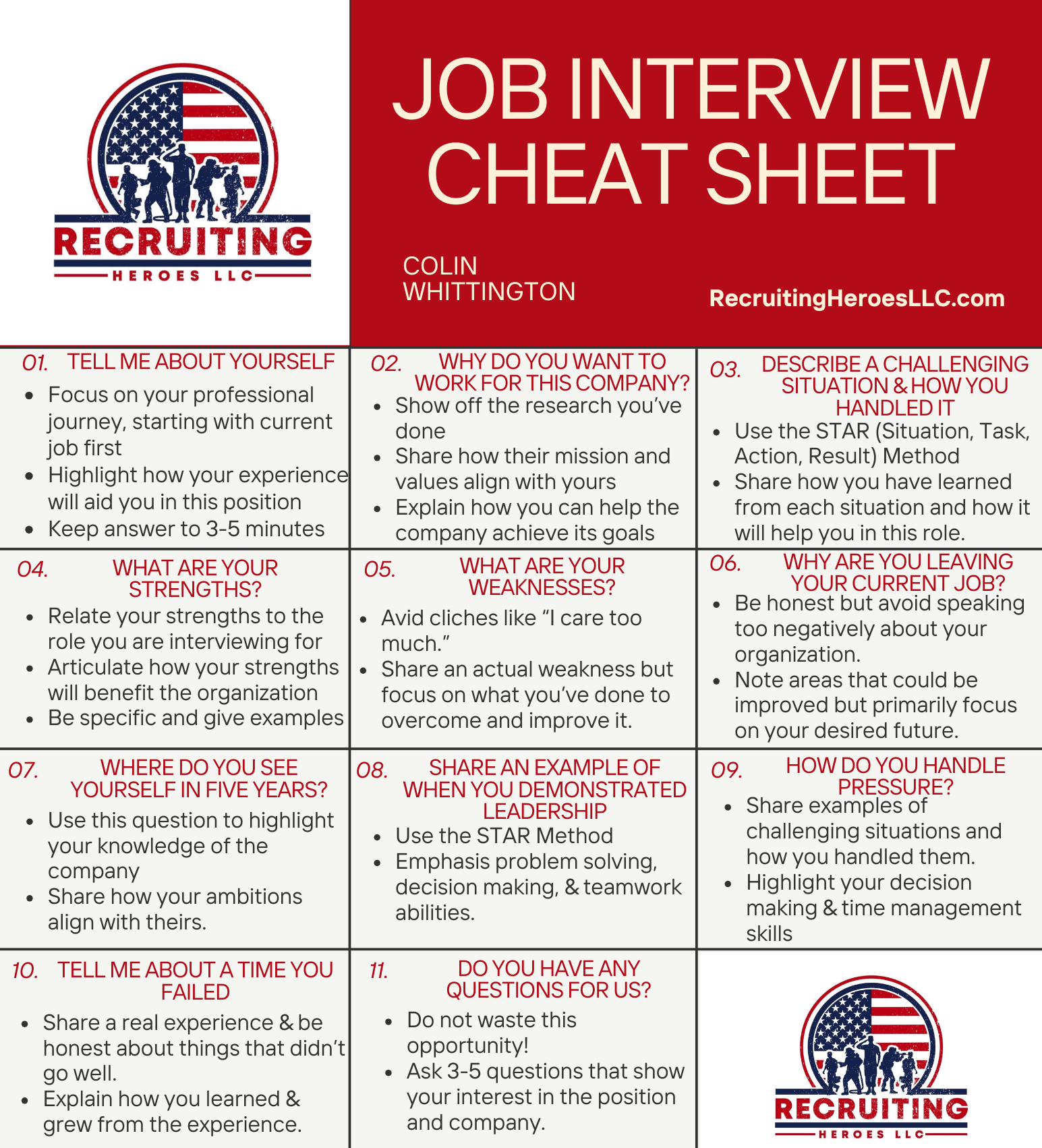
- Tell structured stories using the Problem-Action-Result format. Focus on leadership, interagency coordination, and measurable outcomes.
- Prepare to translate law enforcement experience to private sector language. For example, "surveillance and case file" becomes "incident documentation and chain of custody control for evidence gating and litigation readiness."
- Demonstrate training and readiness to fill any technical gaps. If interviewing for SOC roles, mention labs, home labs, Capture The Flag (CTF) practice, and your Security+ or CySA+ training.
- For federal interviews, practice addressing the KSAs (Knowledge, Skills, and Abilities) and provide exact dates and metrics.
Check out my interview cheat sheet for ideas on answering some of the most common interview questions:
Building on-the-job experience fast
- Volunteer for your agency’s emergency management team or to support exercises and AARs. Those experiences are directly hireable.
- Join local CERT teams or Red Cross disaster response volunteer rosters to get incident exposure outside policing. FEMA Corps and temporary disaster deployment roles build federal experience.
- For cyber roles get practical: set up a small home lab, use free resources and labs from SANS, TryHackMe, or Cyber Ranges, and document projects on GitHub or a technical portfolio.
Example 12-18 month learning plan (compact)
Month 1-3: FEMA SID, IS-100, IS-700, update resume, create LinkedIn headline.
Month 3-6: Earn CompTIA Security+ (if cyber path) or enroll in IAEM Professional Development for CEM track (if emergency management path). Start volunteering for local emergency management exercises.
Month 6-12: Gain a GIAC or CySA+ or CISM depending on path. Apply to targeted positions and network through IAEM, ASIS, or InfraGard chapters.
Example resume bullets tailored for this transition
- Led multi-agency incident response for a mass-casualty training exercise that reduced average mobilization time by 18 percent (track exact metric in your records).
- Coordinated cross-jurisdictional investigations and information sharing with federal partners including DEA and HSI; briefed senior leadership and produced after-action recommendations adopted across the region.
- Implemented an evidence control and documentation protocol that decreased case processing time by X days and improved court readiness.
- Established continuity-of-operations plans for a 500-person division including alternate communications, personnel tracking, and recovery timelines.
When you write these, ask yourself where you can insert an exact number or measurable outcome. If you do not yet have the exact metrics, put a parenthetical reminder to collect them before final submission.
Quick list of high-value resources and links
- FEMA Careers and How to Apply (official FEMA careers page and application guidance). (FEMA)
- USAJOBS federal hiring and resume resources. (USAJOBS)
- FEMA training and NIMS/ICS course catalog (IS-100, IS-200, IS-700, etc.). (FEMA Training)
- IAEM certification and career resources (AEM/CEM). (IAEM)
- CompTIA Security+ and CySA+ certification pages. (CompTIA)
- ISC2 CISSP and Certified in Cybersecurity program. (ISC2)
- SANS Institute and GIAC certification program. (SANS Institute)
- ASIS International membership and security management resources. (ASIS International)
- InfraGard membership information and FBI partnership factsheet. (Federal Bureau of Investigation)
- IAEM Jobs and industry job board. (IAEM Job Board)
Final notes and next steps
Your field experience is more valuable than you may think. Employers are always looking for disciplined, decisive people who know how to operate in chaos and put teams to work. Use the plan above to convert operational wins into credentials, then market them aggressively.
Want to work with me on this process? Reach out and let's get to work!
Stay safe, Heroes!
Colin