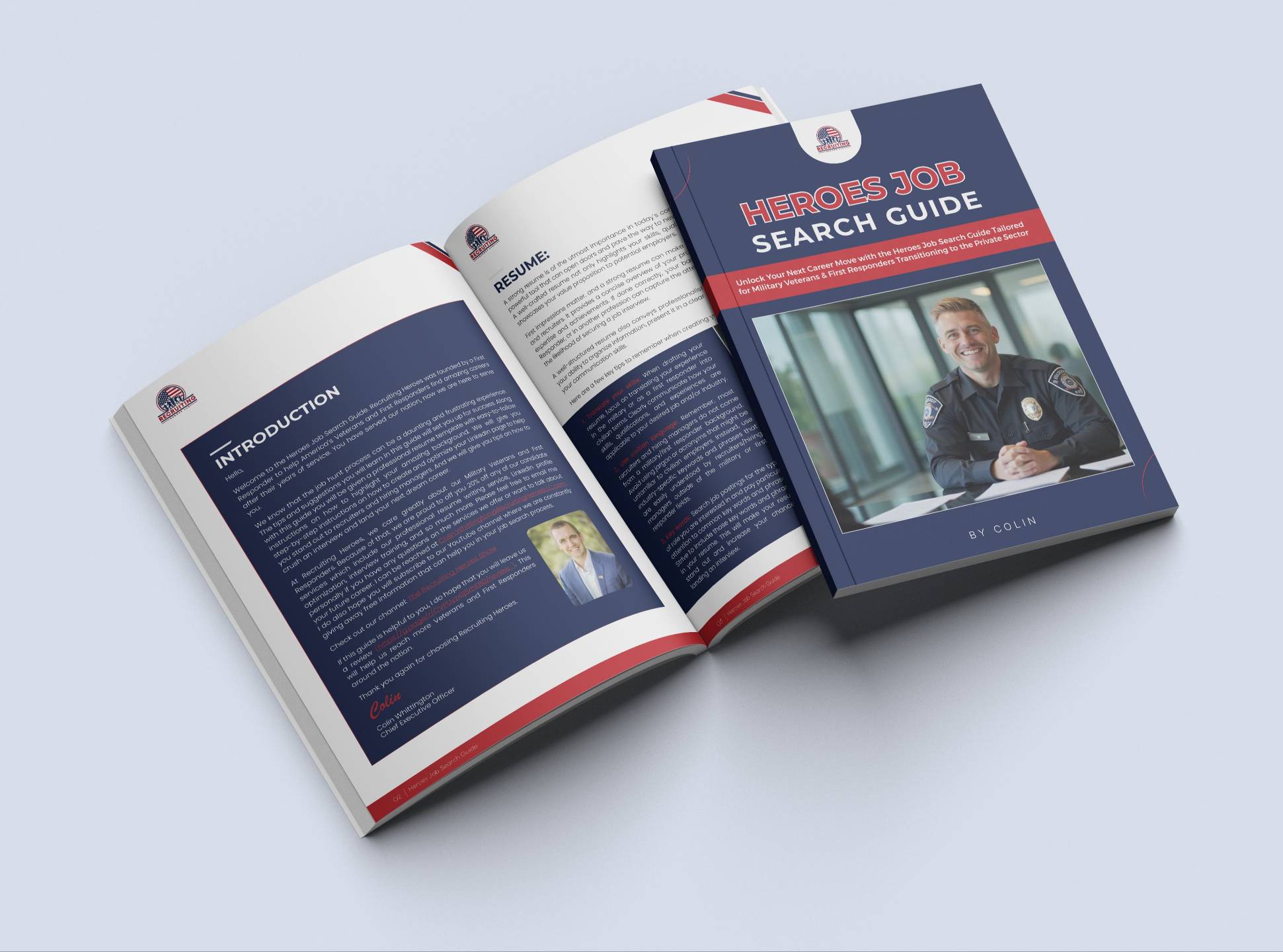
Public Safety to Private Sector Job Search Guide
Aug 04, 2026
Leaving a career in law enforcement, the fire service, emergency services, or the military can be one of the most exciting and intimidating decisions you ever make.
You know that your years of service have prepared you to lead, solve problems, communicate under pressure, manage risk, protect people, and make difficult decisions. The challenge is helping private-sector employers understand that value. Too often, highly qualified veterans and first responders struggle in the job market because their experience is written in language that civilian recruiters do not understand, their LinkedIn profiles do not tell a clear story, or they enter interviews without knowing how to connect their backgrounds to the needs of the company.
That does not mean you are unqualified. It means you need a better strategy for communicating what you bring to the table.
I founded Recruiting Heroes after my own career in law enforcement because I wanted veterans and first responders to have the guidance I wish more people received before making the transition. Since then, I have helped hundreds of law enforcement officers, first responders, and veterans pursue meaningful careers in the private sector.
I highly recommend joining my Private Sector Ops Plan. This program gives you everything I wish I had during my own career transition. It would be an honor to help you with this process. Learn more here: https://www.recruitingheroesllc.com/PrivateSectorOpsPlan
This article will walk you through three of the most important parts of a successful job search: building a strong resume, using LinkedIn strategically, and preparing for interviews.
Part One: Build a Resume That Translates Your Experience
Your resume is often your first opportunity to show a recruiter or hiring manager why you belong in the conversation. It should not simply document everything you have done. It should clearly explain how your experience can help a future employer solve problems, reduce risk, improve operations, protect assets, lead people, or achieve results.
Translate your skills into private-sector language
Veterans and first responders develop highly valuable skills, but those skills are often buried beneath agency terminology, military occupational specialties, unit names, and acronyms.
A corporate recruiter may not immediately understand what it means to serve as an FTO, watch commander, NCO, SWAT operator, background investigator, or emergency management coordinator. Your responsibility is to translate that experience without minimizing it.
For example:
- “Supervised patrol shift” might become “Led daily operations for a team of 12 personnel, coordinated staffing and resources, reviewed work products, addressed performance concerns, and managed high-risk incidents.”
- “Conducted criminal investigations” might become “Managed complex investigations from initial intake through resolution, including interviewing, evidence analysis, records review, stakeholder coordination, and preparation of defensible written findings.”
- “Served as training officer” might become “Designed and delivered performance-based training, evaluated employee readiness, documented progress, and coached personnel through corrective-action plans.”
The underlying experience has not changed. The language now makes its business value easier to understand.
Replace jargon with recognizable terms
Most recruiters and hiring managers have never worked in public safety or the military. Avoid assuming they understand agency-specific abbreviations, unit names, ranks, or technical terminology.
When an acronym or title is important, explain it. More importantly, connect it to a function that exists in the private sector, such as:
- Investigations
- Security operations
- Risk assessment
- Compliance
- Emergency management
- Crisis response
- Training and development
- Program management
- Intelligence analysis
- Business continuity
- Fraud prevention
- Personnel management
- Policy development
- Stakeholder engagement
Your goal is not to disguise your background. It is to make your background accessible to the person deciding whether you receive an interview.
Study job descriptions for keywords
Before writing your resume, review multiple job postings for the roles you want. Pay attention to the skills, responsibilities, systems, and phrases that appear repeatedly.
If several postings mention case management, cross-functional collaboration, regulatory compliance, incident response, data analysis, or executive reporting, those are strong signals about what employers value. When those terms honestly reflect your experience, incorporate them naturally into your resume.
This helps recruiters quickly recognize your fit and may also improve how your resume performs in an applicant tracking system. However, do not simply paste keywords into a skills section. Support them with examples in your professional experience.
Lead with accomplishments, not generic duties
Many public-sector resumes read like job descriptions. They list responsibilities but never show the scale, complexity, or outcome of the work.
Use strong action verbs such as led, developed, implemented, coordinated, analyzed, improved, reduced, trained, investigated, and modernized. Whenever possible, include numbers that show the scope or impact of your work.
Consider details such as:
- Number of personnel supervised
- Annual caseload or call volume
- Size of a budget or geographic area
- Number of people trained
- Frequency of major events or critical incidents
- Time or money saved
- Reduction in errors, injuries, vacancies, or processing time
- Improvement in compliance, readiness, response time, or productivity
- Number of partner agencies or stakeholders involved
For example:
Trained and mentored 20 officers, improving team readiness and consistency during critical assignments.
Developed a new safety-training program that reduced preventable training injuries by 25 percent.
Coordinated multi-agency response operations involving more than 10 local, state, and federal partners.
Numbers give employers context. They help transform a vague responsibility into a credible professional accomplishment.
Highlight relevant training and certifications
Veterans and first responders often complete extensive training that private-sector candidates may not have. Include certifications and specialized instruction that support your target role, but be selective.
Cybersecurity certifications may be important for a security operations position. FEMA and Incident Command System credentials may strengthen an emergency management application. Interview and interrogation training may support an investigations role. Instructor credentials may be valuable for learning and development, customer training, or program management positions.
Prioritize what is relevant to the job rather than listing every course you have ever attended.
Keep the format clean and focused
A private-sector resume should normally be no longer than two pages. Use a professional font, clear section headings, consistent spacing, and a format that is easy to scan.
A strong structure may include:
- Name and contact information
- Targeted professional headline
- Brief career summary
- Two or three professional highlights
- Eight to twelve relevant areas of expertise
- Professional experience in reverse chronological order
- Education
- Relevant certifications and training
- Awards and honors, when appropriate
Your resume does not need to be flashy. It needs to be clear, credible, tailored, and easy to understand.
Part Two: Turn LinkedIn Into a Job-Search Tool
A strong resume is essential, but it is only one part of the process. LinkedIn gives you something a resume cannot: visibility, discoverability, and direct access to recruiters, hiring managers, industry leaders, and potential referral partners.
Your profile should reinforce the same professional story told by your resume.
Use a professional profile photo and background image
Your photo is often the first thing people notice. Use a clear, recent headshot with professional clothing, good lighting, and a simple background. You do not necessarily need to hire a photographer, but the image should look intentional.
Add a background image as well. A thoughtful banner makes the profile feel complete and can reinforce your target field, personal brand, location, or professional interests.
Write a headline for where you are going
Your LinkedIn headline should do more than repeat your current job title. Use it to communicate your experience, strengths, and career direction.
Examples include:
- Senior Investigator | Threat Assessment | Corporate Security | Risk & Compliance
- Emergency Management Professional | Crisis Response | Business Continuity | Organizational Resilience
- Military Veteran Transitioning to Cybersecurity | Risk Assessment | Incident Response | Security Operations
- Public Safety Leader | Training & Development | Program Management | Operational Leadership
Recruiters search LinkedIn using job titles and skills. A clear, keyword-rich headline improves the likelihood that the right people will find you.
Create an About section that tells your story
The About section gives you room to connect the dots between your service, your strengths, and your future.
A useful structure is:
- Begin with a short statement about who you are professionally.
- Summarize your most relevant experience and accomplishments.
- Identify the transferable skills you offer.
- Explain the types of roles or industries you are pursuing.
- End with an invitation to connect.
Write in the first person and allow some personality to come through. Your profile should sound like a capable human being, not a collection of keywords.
Complete your experience and skills sections
Do not leave your LinkedIn experience section with only titles and dates. Add concise descriptions and accomplishment-focused bullets from your resume. Make sure your employer, agency, or military branch is correctly linked when possible.
You should also attach relevant skills to each position and maintain a broader skills section that supports your career goals. Recruiters frequently search for candidates using these terms.
Complete the education, licenses and certifications, honors and awards, and featured sections as well. Your Featured section can showcase media coverage, articles, presentations, projects, professional accomplishments, or other work that demonstrates credibility.
Be thoughtful before publicly posting your complete resume because it contains personal contact and work-history information. If you choose to feature it, consider using a version that omits your street address and any sensitive details.
Set your job preferences
If you are actively searching, use LinkedIn's Open to Work settings. Depending on your circumstances, you may choose to make your status visible to everyone or limit it to recruiters.
Add the job titles, work arrangements, and locations you would realistically consider. Recruiters often filter searches using these preferences, so completing them can improve your visibility.
Build relationships instead of only submitting applications
One of the biggest mistakes job seekers make is relying entirely on online applications. Applications matter, but relationships often create access that an application alone cannot.
Connect with:
- Former colleagues who have entered the private sector
- Recruiters in your target industries
- Professionals holding the job titles you want
- Hiring managers and company leaders
- Alumni from your agency, military branch, school, or training programs
- People you meet at conferences, webinars, and professional events
Personalize your outreach. Do not immediately ask a stranger for a job. Start a genuine conversation, express interest in their career path, and ask a thoughtful question.
You can also improve your visibility by posting about professional lessons, training, accomplishments, projects, industry news, and your transition. Comment thoughtfully on other people's content. Consistent participation helps people remember who you are and what you offer.
Network around specific job openings
When you find a promising position, visit the company's LinkedIn page and review its employees. Look for recruiters, talent-acquisition professionals, hiring managers, team leaders, and people in similar roles.
Send a concise, personalized message that identifies the position, briefly explains your relevant background, and expresses genuine interest in the organization. You will not receive a response every time, but a thoughtful message can help you stand out from hundreds of applicants.
Part Three: Prepare to Win the Interview
An interview is not simply a conversation about your past. It is your opportunity to demonstrate how your past prepares you to succeed in this company's future.
Research the company
Before the interview, study the organization's website, LinkedIn page, products, services, customers, values, and recent developments. Understand what the company does, how it makes money, and why the role matters.
Be prepared to answer:
- Why do you want to work here?
- What do you know about our company?
- Why are you interested in this position?
A generic answer suggests a generic level of interest. A specific answer shows preparation and commitment.
Understand the job description
Read the posting several times. Identify the five or six most important responsibilities and qualifications. Then prepare examples from your career that demonstrate each one.
If the company needs someone who can manage investigations, work across departments, analyze risk, write executive reports, or respond to urgent incidents, you should enter the interview with a specific story for each skill.
Practice your answers
Many veterans and first responders have not completed a civilian interview in years. Practice is essential.
Prepare for common questions such as:
- Tell me about yourself.
- Why are you leaving public service or the military?
- Why do you want this role?
- What are your greatest strengths?
- What is an area you are working to improve?
- Tell me about a difficult decision you made.
- Describe a conflict with a colleague and how you resolved it.
- Tell me about a mistake and what you learned.
- How do you operate as part of a team?
Practice aloud with a friend, family member, coach, or camera. You want your responses to sound confident and organized, but not memorized.
Use the STAR method
Behavioral interview questions often begin with phrases such as “Tell me about a time” or “Give me an example.” Structure those answers using the STAR method:
- Situation: Briefly describe the context.
- Task: Explain the challenge, responsibility, or objective.
- Action: Describe the specific steps you took. Focus on your contribution.
- Result: Explain the outcome, impact, or lesson learned. Include measurable results when possible.
The Action portion should receive most of your attention. Interviewers need to understand what you did, why you chose that approach, and which skills you used.
Avoid getting lost in operational details or telling a long “war story.” Choose only the details needed to demonstrate judgment, leadership, communication, analysis, or another skill relevant to the position.
Make a professional impression
Confirm the interview format and location ahead of time. For an in-person interview, arrive early and bring several copies of your resume. For a virtual interview, test your camera, microphone, lighting, background, and internet connection.
Dress professionally, maintain attentive posture, and make natural eye contact. Confidence matters, but so do humility, curiosity, and the ability to communicate with people who do not share your background.
Prepare questions of your own
Most interviewers will ask whether you have questions. Saying no can make it appear that you did not prepare or are not seriously evaluating the opportunity.
Consider asking:
- How will success be measured during the first six to twelve months?
- What are the most important challenges facing this team?
- What qualities have helped people succeed in this role?
- How does this position work with other departments?
- What are the team's immediate priorities?
- How would you describe the company culture?
- Is there anything about my background that you would like me to clarify?
Your questions should help you learn while also demonstrating that you are already thinking like a member of the team.
Follow up within 24 hours
Send a short thank-you email to each person who interviewed you. Thank them for their time, reference something specific from the conversation, and restate your interest in the position.
The note does not need to be long. It simply needs to be prompt, personal, and professional.
Your Service Has Prepared You for What Comes Next
The private-sector job search can be slow, frustrating, and unfamiliar. You may apply for roles you are qualified for and never receive a response. You may have to explain your background repeatedly. You may even begin to question whether employers recognize the value of your service.
Do not confuse a difficult process with a lack of potential.
You have already operated in demanding environments, adapted to uncertainty, learned complex systems, worked with diverse teams, and accepted responsibility when the stakes were high. Those experiences can create tremendous value for a private-sector employer. Your job is to translate them, target them, and communicate them with confidence.
Build a resume that focuses on business value. Create a LinkedIn profile that makes your direction clear. Develop relationships before you need them. Prepare specific examples for interviews. Then remain consistent.
At Recruiting Heroes, helping law enforcement officers, first responders, and military veterans make this transition is not simply part of what we do. It is why we exist. Whether you need professional resume writing, a complete Private Sector Ops Plan, hands-on reverse recruiting, or continued education and coaching through Heroes Academy, support is available.
Your uniform, badge, gear, or military title may have been part of your identity for years. Leaving that role does not erase the skills, character, and leadership you developed through service. It gives you the opportunity to use them in a new way.
Your next career is out there. Now it is time to prepare for it.